
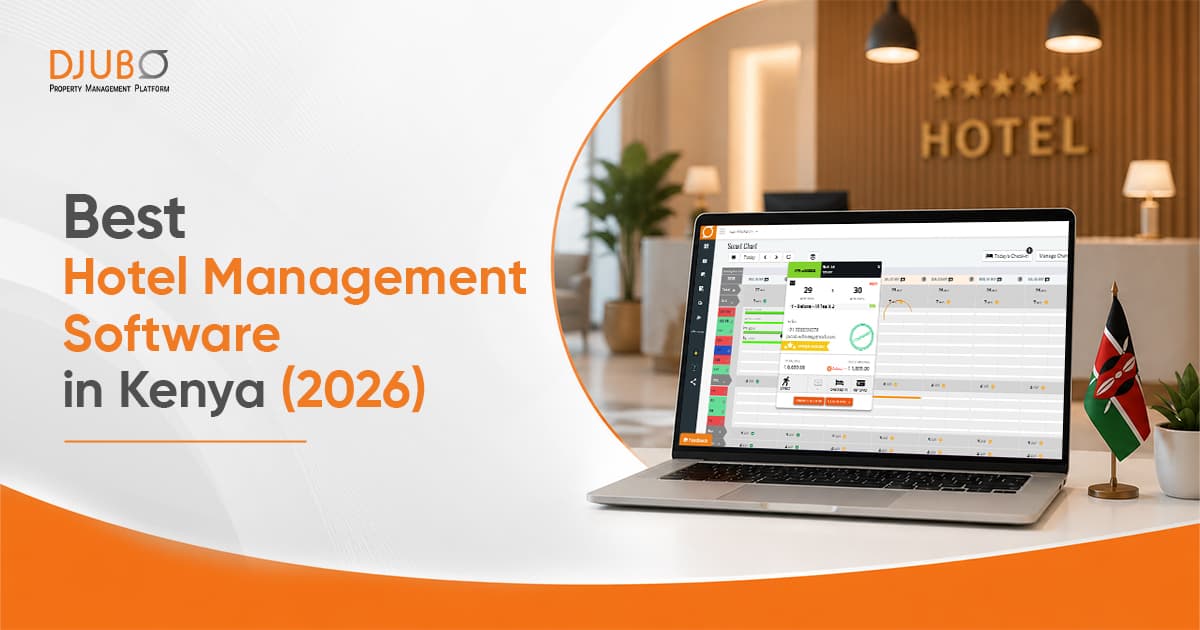
Choosing hotel management software in Kenya in 2026 is not the same as choosing it anywhere else. You need M-Pesa integration. You need a system that works on mobile data for remote safari lodges. You need a channel manager that connects to SafariBookings, not just Western OTAs. And you need pricing that makes sense for the Kenyan market.
This guide cuts through the generic PMS marketing and explains what Kenyan hotels — city business hotels, coastal resorts and safari lodges — actually need from their hotel management software, and what to look for when choosing one.
What a hotel PMS actually does · Must-have features for Kenyan hotels · What city hotels need vs safari lodges · How to evaluate PMS pricing · Why DJUBO was built for markets like Kenya · Real customer feedback
What does hotel management software actually do?
A hotel property management system (PMS) is the central software that runs your hotel's front desk operations. At its core, a PMS manages:
- Reservations — a live chart of all bookings across all sources
- Check-in and check-out — guest folios, room assignment, key handover
- Housekeeping — room status, cleaning assignments, maintenance
- Billing and payments — guest charges, M-Pesa, cards, invoicing
- Reporting — occupancy, revenue, ADR, RevPAR, channel performance
In 2026, the best hotel management software also connects natively to your channel manager (so OTA bookings flow into the PMS automatically), your booking engine (so direct website bookings are created instantly), and your payment gateway (so M-Pesa and card payments post to folios without manual entry).
If any of those connections are manual — if your front desk staff copy bookings from OTA extranets into your PMS, or reconcile M-Pesa statements against folios at end of day — your system is costing you time and creating errors every single day.
The 10 features every Kenyan hotel needs from a PMS in 2026
Not all PMS features matter equally for the Kenyan market. Here is what to prioritise:
- M-Pesa STK Push integration — not just Paybill, but proper STK Push via Pesapal or Paystack so amount errors and reconciliation are eliminated
- Native channel manager — OTA bookings arrive in your PMS automatically, not via email or manual entry
- Direct booking engine — with M-Pesa payment accepted on your hotel website
- Multi-currency billing — KES for local guests, USD or EUR for international tourists at safari lodges and coastal resorts
- Mobile app that works on mobile data — for lodge managers at remote properties
- Cloud-based with no local server — no IT infrastructure required, accessible from any device
- Housekeeping management — room status tracking and staff assignment from a mobile app
- Real-time analytics and reporting — occupancy, RevPAR, channel mix, revenue by source
- Multi-property management — a head-office view for hotel groups across Kenya
- Local support — a team that understands the Kenyan market and is reachable via WhatsApp
What different Kenyan property types need from their PMS
A Nairobi business hotel and a Maasai Mara safari lodge have very different operational requirements. The best hotel management software for Kenya needs to serve both.
🏢 Nairobi & Mombasa city hotels
- High check-in/check-out volume
- Corporate billing and invoicing
- M-Pesa for domestic guests
- Conference and events module
- Multi-property for hotel groups
- Integration with Booking.com, Expedia
🦁 Safari lodges & coastal resorts
- Works on mobile data (remote locations)
- USD/EUR billing for international guests
- Seasonal rate plan management
- All-inclusive and package billing
- SafariBookings OTA integration
- Mobile housekeeping across large layouts
The real cost of using the wrong PMS in Kenya
Many Kenyan hotels underestimate what a fragmented or manual system actually costs them. Here is what happens in practice:
- OTA bookings copied manually into the PMS — 10–15 minutes per booking, errors on busy days, occasional double-bookings that require compensation
- M-Pesa reconciliation done manually — accounts team matching Safaricom statements to guest folios every evening; a 1–2 hour daily task that still produces errors
- No direct booking engine — 100% of online bookings come through OTAs at 15–25% commission; zero direct revenue from the hotel website
- Rates updated manually across OTA extranets — a reservation manager spending 30–60 minutes every morning logging into Booking.com, Expedia, Agoda and others to update availability
Across a 50-room hotel doing 70% average occupancy, these manual processes add up to thousands of shillings in staff time daily and tens of thousands in lost revenue monthly from missed direct bookings and OTA commission on bookings that could have been direct.
What makes DJUBO the right choice for Kenyan hotels
DJUBO is a fully integrated, cloud-based hotel management platform used by 2,500+ hotels across 19 countries. For Kenyan hotels specifically, it offers several things that generic international PMS platforms do not.
M-Pesa built in — not bolted on
Most international PMS platforms have no M-Pesa support at all. DJUBO integrates M-Pesa STK Push and Paybill via Pesapal — so payments made at the front desk and through your booking engine post to guest folios automatically. No separate reconciliation. No manual entry.
All-in-one platform — not a PMS with add-ons
DJUBO's PMS, channel manager, booking engine and payment processing are natively integrated — not connected via third-party APIs that can break. When a guest books on Booking.com, the reservation appears in your PMS and your website availability updates within seconds.
Safari and coastal OTAs included
DJUBO connects to 130+ OTAs including SafariBookings and Hotelbeds — the channels that actually drive bookings for Maasai Mara lodges and Diani coastal resorts — alongside mainstream channels like Booking.com, Expedia and Airbnb.
Mobile app that works on mobile data
DJUBO PMS comes with a mobile application that works on mobile data, making it reliable for lodge managers and resort teams who need to manage operations from their phone rather than a desktop.
"What sets DJUBO apart is its all-in-one system — PMS, channel manager, booking engine and M-Pesa payments working together seamlessly. Exactly what independent hotels and safari lodges in Kenya need."Purity MmayiDominus Hospitality Limited · DJUBO Kenya Partner
"Ease of use. Good customer support. Easy channel management. Ability to control on mobile. Good statistics to help in decision-making."James GitauHotel Owner · Nairobi, Kenya
How to evaluate hotel management software for your Kenya property
When comparing PMS options, ask these questions directly of any vendor:
- Does it support M-Pesa STK Push — not just Paybill, but STK Push via an integrated gateway?
- Does the channel manager connect to SafariBookings and Hotelbeds, not just Booking.com?
- Does the booking engine accept M-Pesa at the point of online booking?
- Is there a mobile app that works on mobile data?
- Is the pricing in USD or KES, and what does the full cost look like — setup, monthly fee, per-booking fees?
- Is there Kenya-based support or at minimum a team reachable on WhatsApp during EAT business hours?
- How long does onboarding take, and who handles data migration?
M-Pesa STK Push via Pesapal ✓ · SafariBookings and Hotelbeds ✓ · M-Pesa on booking engine ✓ · Mobile app on mobile data ✓ · Transparent pricing ✓ · Kenya support via WhatsApp ✓ · 7–14 day onboarding, fully managed ✓
Ready to see the right hotel PMS for your Kenya property?
DJUBO goes live on most Kenyan hotels in 7–14 working days. Our team handles data migration, OTA connection, payment gateway setup, and staff training — you do not need a technical team to get started.
Book a free PMS demo
See DJUBO running on a property similar to yours — Nairobi business hotel, coastal resort or safari lodge. Our team will walk you through the platform and give you transparent pricing for your property size.
Book a free demo →