Unlike earlier times when booking a hotel room was a tedious job, today it is just a matter of a few clicks or a few calls. There are many ways of making a hotel reservation — a hotel gets booking inflow from various sources. These are broadly distinguished into two categories:
- Online sources
- Offline sources
Online Sources
Any booking flowing through an online source is termed an online booking. Online sources are further divided into two parts:
Direct Online Sources
A direct online source means the entire booking journey is between the hotel and the customer, with no online aggregator involved. For example, a booking made through the hotel's website using its booking engine.
In this scenario, the customer has directly approached the hotel for their reservation, and no aggregator company is involved. This is the most profitable booking channel as hotels retain 100% of the revenue.
Indirect Online Sources
An indirect online booking source is a booking where the generation source is from an aggregator or third-party online booking platform. Hotels need to pay a commission to the service provider for each such booking. There are two main types:
OTAs (Online Travel Agents)
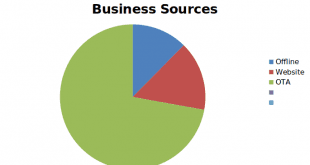
In today's era, the main chunk of hotel business is dependent on online travel agents. More than 70% of business is generated by these platforms, making it essential for hotels to list themselves on as many OTA platforms as possible to gain maximum visibility.
When a guest decides to book from any OTA platform — say Booking.com — the booking is pushed to the hotel by the OTA, and the hotel pays a commission (typically 15–25%) for the service.
Meta-Search Engines
Meta-search engines are platforms that aggregate rate data from across the web. When a user searches for a hotel on TripAdvisor or Google Hotel Ads, they see all the rates from various platforms — including the hotel's direct website — under a single window. The guest can choose to book from any of these options.
Offline Sources
Any booking where manual intervention is required at every step is termed an offline source. These include:
- Phone calls: Reservation centres receive many enquiry calls daily from customers asking about room availability and best offers
- Email enquiries: Guests or corporate travel desks reaching out via email
- Offline travel agents: A major share of offline bookings comes from travel agents and destination management companies
- Walk-ins: Guests who arrive at the hotel without a prior reservation
The Challenge of Managing Multiple Sources
With so many diverse booking sources, the workload on hotel reservation staff becomes significant. Managing limited room inventory across all these channels in an error-free manner is extremely difficult manually. This increases the scope of errors — leading to overbookings or under-bookings that directly impact guest satisfaction and revenue.
How Cloud-Based Hotel Software Solves This
Modern cloud-based hotel reservation software with an integrated channel manager bridges the gap between all booking sources and enables the entire reservation system to work in sync with actual inventory status.
Real-Time Inventory Updates
The channel manager fetches live inventory from the hotel CRS and pushes updates to all OTA extranets simultaneously. Every time there is a change in inventory status, all channels are updated automatically — eliminating manual updates and reducing errors.
Accurate Booking Source Tracking
With every online booking, the system registers the source automatically. This data can be generated in report form, simplifying the reporting task and giving hotels clear visibility into which channels drive the most business.
Centralised Reservation Monitoring
A cloud-based system enables hotels to manage all reservations from a single dashboard, regardless of the source. This gives a better understanding of inventory position and allows reservation managers to optimise available inventory for maximum revenue.
Easy Integration
Cloud-based systems integrate with ancillary solutions — booking engine, POS, revenue management — enabling centralised monitoring of the entire operation under a single system.
Interdepartmental Coordination
By connecting all major departments, cloud hotel software facilitates better information flow, helps uplift service standards, and contributes to a positive guest experience that builds goodwill through word of mouth.
Whether bookings come from OTAs, metasearch, your own website, phone calls, or walk-ins — managing them all from one system is no longer a luxury. It's a necessity for any hotel that wants to maximise revenue and deliver a seamless guest experience.